what percentage of americans list love as the most important reason to marry?
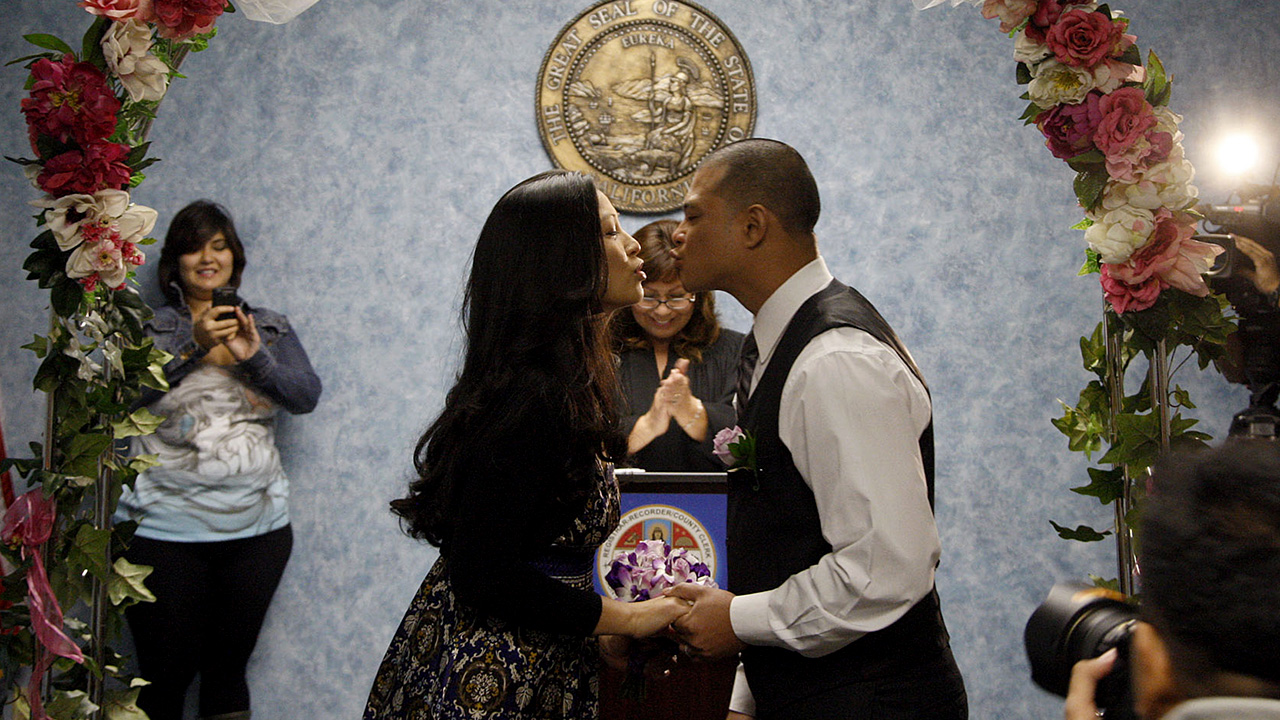
The mural of relationships in America has shifted dramatically in contempo decades. From cohabitation to same-sex marriage to interracial and interethnic marriage, here are 8 facts about love and marriage in the United states.
oneOne-half of Americans ages 18 and older were married in 2017, a share that has remained relatively stable in recent years simply is downward 8 percentage points since 1990.Ane gene driving this change is that Americans are staying single longer. The median age at get-go union had reached its highest signal on record: 30 years for men and 28 years for women in 2018, according to the U.S. Census Bureau.
Every bit the U.S. marriage rate has declined, divorce rates have increased among older Americans. In 2015, for every 1,000 married adults ages fifty and older, x had divorced – up from five in 1990. Among those ages 65 and older, the divorce charge per unit roughly tripled since 1990.
2 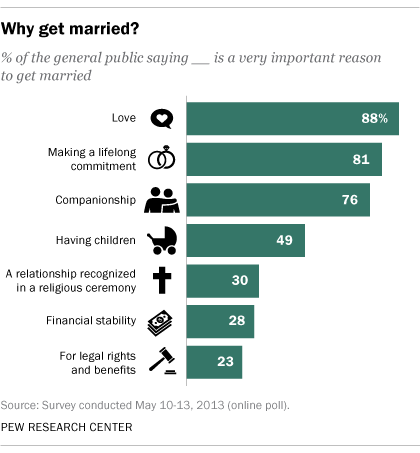 Love tops the list of Americans' reasons to marry.About nine-in-10 Americans (88%) cited dearest as a very important reason to get married, ahead of making a lifelong delivery (81%) and companionship (76%), according to a 2013 Pew Research Centre survey. Fewer said having their relationship recognized in a religious ceremony (30%), fiscal stability (28%) or legal rights and benefits (23%) were very important reasons to ally.
However, being a good financial provider was seen as particularly important for men to be a expert hubby or partner, according to a 2017 survey by the Center. About seven-in-ten adults (71%) said information technology was very of import for a man to exist able to support a family unit financially to exist a good hubby or partner, while just 32% said the same for a adult female to be a good wife or partner.
Every bit far as what helps people stay married, married adults said in a 2015 survey that having shared interests (64%) and a satisfying sexual relationship (61%) were very of import to a successful wedlock. More than half (56%) also named sharing household chores.
3The number of U.S. adults cohabiting with a partner is on the rise.In improver to the half of U.S. adults who were married, seven% were cohabiting in 2016. The number of Americans living with an unmarried partner reached virtually 18 meg in 2016, upwards 29% since 2007. Roughly half of cohabiters are younger than 35 – but cohabitation is rising most chop-chop among Americans ages 50 and older.
Large majorities of Generation Zers, Millennials, Generation Xers and Baby Boomers say couples living together without beingness married doesn't make a departure for our order, according to a 2019 Pew Research Heart written report. While 54% of those in the Silent Generation say cohabitation doesn't make a difference in society, about 4-in-ten (41%) say it is a bad affair, compared with much smaller shares among younger generations.
4 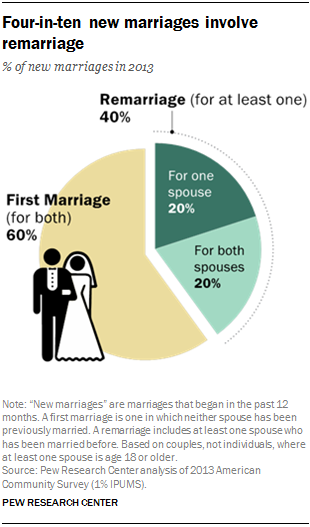 Remarriage is on the rise.In 2013, 23% of married people had been married earlier, compared with just 13% in 1960. Four-in-x new marriages in 2013 included a spouse who had said "I exercise" (at least) once before, and in xx% of new marriages both spouses had been married at least once before.
Remarriage is more mutual among men than women. Among previously married men (those who were ever divorced or widowed), 64% took a 2d walk downwardly the aisle, compared with 52% of previously married women, according to a Pew Research Center assay of 2013 Census Agency data. 1 possible reason for this disparity is that women are less interested than men in remarrying. Among previously married women, 54% said in a 2014 Pew Research Heart survey that they did not desire to marry again, compared with 30% of men.
5 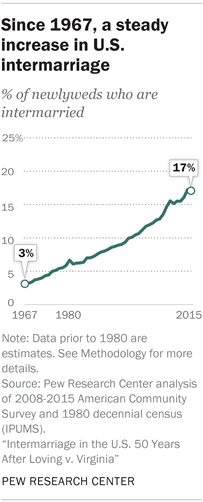 One-in-six newlyweds (17%) were married to someone of a different race or ethnicity in 2015. This reflects a steady increase in intermarriage since 1967, when merely 3% of newlyweds were intermarried, according to a 2017 Pew Research Center analysis.
While Asian (29%) and Hispanic (27%) newlyweds are most likely to intermarry in the U.S., the about dramatic increases in intermarriage have occurred amid blackness newlyweds, 18% of whom married someone of a dissimilar race or ethnicity, upwards from 5% in 1980. About 1-in-10 white newlyweds (eleven%) are married to someone of a dissimilar race or ethnicity.
Amongst both Gen Zers and Millennials, 53% say people of different races marrying each other is a good thing for our society, compared with 41% of Gen Xers, 30% of Boomers and 20% of those in the Silent Generation, co-ordinate to the Eye'southward 2019 report.
viSupport for the legalization of same-sex activity matrimony has grown in the past 10 years . In 2007, Americans opposed legalizing same-sexual practice marriage by a margin of 54% to 37%. In 2017, more favored (62%) than opposed (32%) allowing gays and lesbians to marry legally.
Surveys conducted by Gallup establish that about one-in-x LGBT Americans (10%) were married to a same-sexual activity spouse in 2017. Now, a bulk (61%) of all same-sex couples who live together are married.
seven 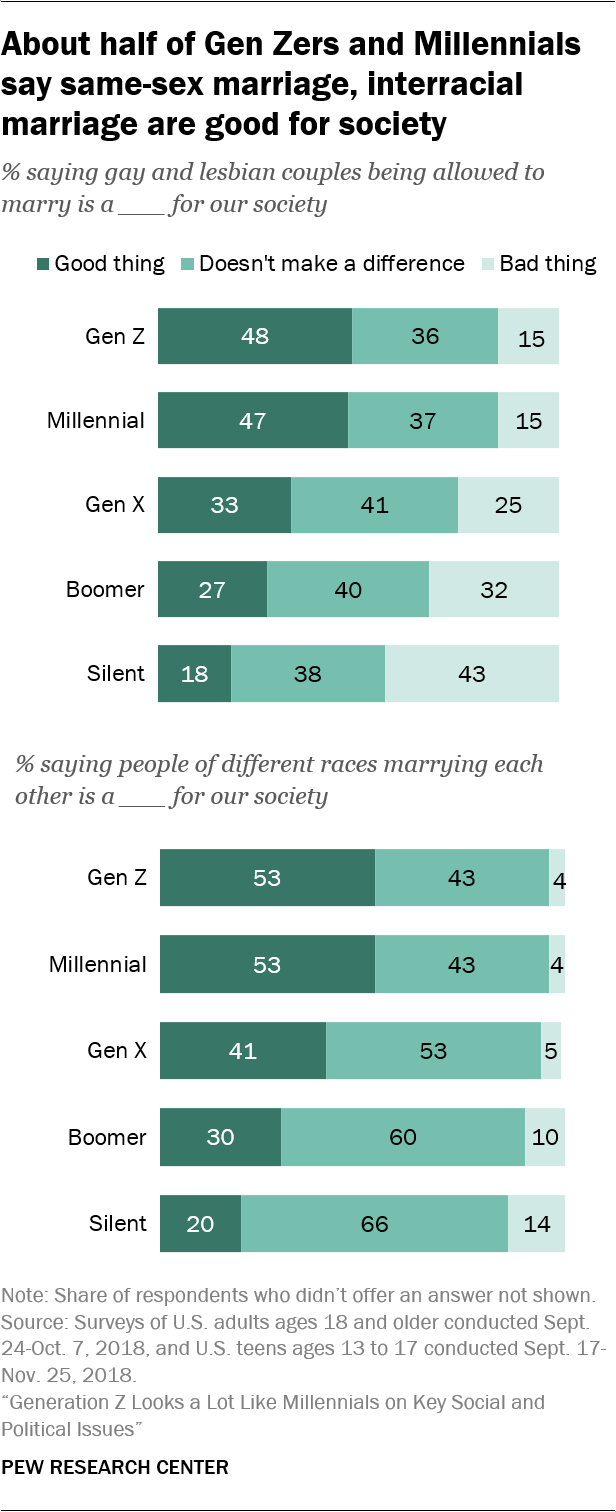 Millennials and Generation Z have been at the vanguard of changing views on same-sex matrimony. About half of Gen Zers and Millennials say gay and lesbian couples being immune to marry is a skillful thing for our social club, while 33% of Gen Xers, 27% of Boomers and 18% of Silents say the same, according to the 2019 report.
8Sizable minorities of married people are members of a different religious group than their partner, but marriages and partnerships across political political party lines are relatively rare.Almost four-in-ten Americans who take married since 2010 (39%) accept a spouse who is in a different religious group, compared with only 19% of those who wed earlier 1960, according to a 2014 Pew Research Heart survey. Many of these interfaith marriages are between Christians and those who are religiously unaffiliated.
When it comes to politics, a 2016 Pew Research Heart survey found 77% of both Republicans and Democrats who were married or living with a partner said their spouse or partner was in the same party.

A.Westward. Geiger is a one-time associate digital producer and writer for Pew Inquiry Eye.

Gretchen Livingston is a former senior researcher focusing on fertility and family demographics at Pew Research Center.
Source: https://www.pewresearch.org/fact-tank/2019/02/13/8-facts-about-love-and-marriage/
0 Response to "what percentage of americans list love as the most important reason to marry?"
Post a Comment